
For Andrew Cyrille
An unforgettable set at the Vanguard; Cyrille's earliest records.

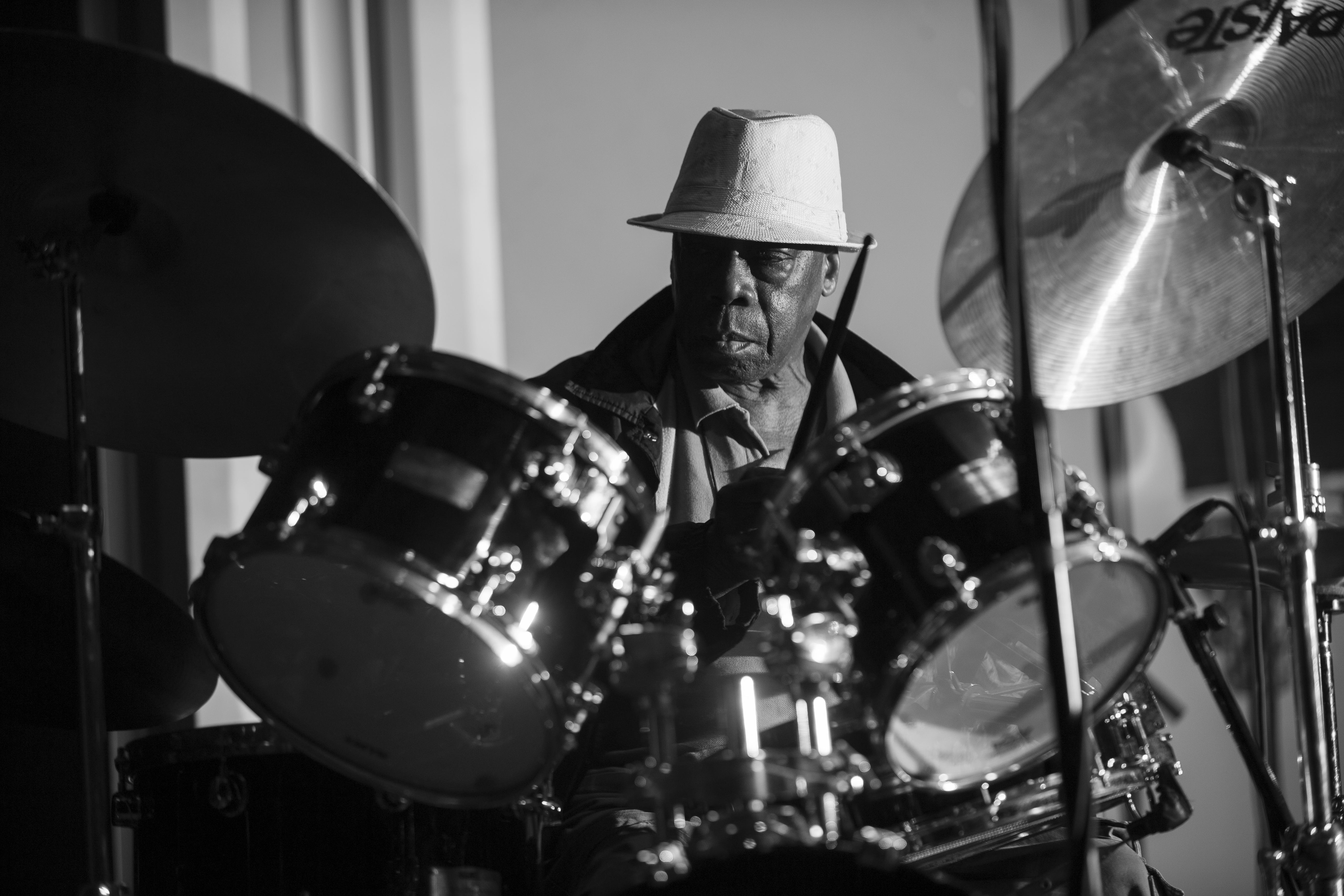
Onstage at the Village Vanguard in August, drummer Andrew Cyrille was a grand, magisterial presence. Along with Louis Hayes (born 1937) and Billy Hart (born 1940), Andrew Cyrille, born in 1939, connects the music’s illustrious past with all present concerns. We are so lucky to have him with us.
Joined by his long-time quartet of Bill Frisell, David Virelles, and Ben Street, Andrew wove his stark choices and minimal gestures— a roll on the cymbals, some scattershot snare tattoos, a single bass drum hit, broken time— into complete musical statements. You could ignore the band, listen to just Cyrille, and hear a symphony. He’s just wonderful.
The night started with Julius Hemphill’s “The Painter”1, emphasizing the gentle folk song at the tune’s core. With the elocution and stage presence of a classical actor, Andrew dedicated the next song to the memory of trombonist John Gordon2. Hauntingly titled “Proximity”, the piece extended the reflective quietude of the “The Painter”.
Eventually, the memories and chamber-like atmosphere gave way to something ebullient and boisterous. Towards the end, after a swinging Ben Street original, Andrew took to the mic and talked about his childhood in Brooklyn: playing a drum for the first time ever in his schoolroom (paradiddles on a calfskin head3), meeting Brooklyn drummers Willie Jones (Charles Mingus, Monk, and Lester Young), Lenny McBrowne (Paul Bley, Booker Ervin, Sonny Criss, and Barry Harris), and, of course, the great Max Roach, Cyrille’s boyhood neighbor.
When Andrew put down the mic and started playing, the message was clear: this is how I got here. He was telling his earliest story, honoring the friends, teachers, and neighbors who were there at the beginning. Amen.
The set closed with Frisell’s blues “Go Happy Lucky”, tying the night together in a perfect bow. After those stories, Bill’s unforgettable melody simply was Andrew Cyrille, going happily and luckily. I floated out of the Vanguard, humming “Go Happy Lucky”, and thinking about Cyrille’s story. It was one of those magic nights. Weeks later, I’m still sort of at the Vanguard, listening to Andrew.
For the past decade or so, I’ve been lucky to hear Andrew Cyrille a lot: with co-operative bands (Trio 3 at the Blue Note), as a sideman (Joe Lovano, Village Vanguard), all-star tributes (Coltrane’s birthday with Steve Kuhn and Lonnie Plaxico at Birdland), in Brooklyn (with Tim Berne and Michael Formanek at Korzo), and as a leader at the Vanguard.
But as I rode the train home, I realized that while Andrew had just told us the very beginning of his musical life, it was time to get some records and do some listening to his early career. I didn’t know any of his early music. Here’s what I found:
Andrew Cyrille’s first recording is with none other than Coleman Hawkins, the inventor of the jazz tenor saxophone. What a beginning! The Hawk Relaxes (Prestige, 1961), a great Hawkins ballad session for Prestige’s Moodsville (their ‘mood music’ imprint), finds Hawkins and Cyrille joined by pianist Ronnell Bright4 and Detroiters Kenny Burrell and Ron Carter. Opening with a definitive “I’ll Never Be The Same” taken at a walk, Hawkins gives us a fetching “Moonglow”, but it’s Andrew’s cha-cha and hook-up with Ron Carter on “Speak Low” that gets my attention.
Seven days after the Hawkins session, on March 7, 1961, Cyrille was back at Van Gelder’s to record This Is Walt Dickerson, the vibraphonist’s debut. Startlingly, on his second record date, Cyrille’s sound and conception are totally recognizable; this is the Cyrille we all know. Good as he sounds on The Hawk Relaxes, Andrew has much more room to contribute with Walt Dickerson.
On “Time”, Andrew’s still and focussed cymbal beat creates the track’s pensive mood. Cyrille’s intensity and focus on “The Cry”, worrying the mambo bell and conga pattern for the entire take, with only the slightest textural or dynamic variations, is likewise a standout.
Dickerson is one of the more elusive figures in the music5, a deeply original voice from the Philadelphia jazz community, the community that has nurtured some of the most distinctive voices ever. Playing with Walt Dickerson, Andrew Cyrille is right where he belongs.
Bassist Ahmed Abdul Malik, best-known as a member of Thelonious Monk’s quartet6, was among the first to bring Arabic instruments into jazz. The Music of Ahmed Abdul Malik (New Jazz, 1961), the bassist’s debut as a leader, features oud (played by Malik himself), Korean piri (played by Bilal Abdurahman, an important part of the NYC Muslim community), and cello, with Cyrille, tenor saxophonist Eric Dixon, and trumpeter Tommy Turrentine the only nods to jazz convention.
On “Nights On Saturn” (the liner notes make no mention of Sun Ra), Cyrille holds down 5/4 while Malik, cellist Calo Scott, and Turrentine play around and away from Cyrille’s tempo. “La Ibkey” works the same way, with Cyrille in 7 and the oud, percussion, Turrentine, and Dixon in 4/4. This was all but unprecedented in May 1961. Clearly, change was afoot in the music, and Andrew Cyrille was at the forefront.
In March 1962, tenor saxophonist Bill Barron (older brother of Kenny Barron) recorded Hot Line, perhaps the most straight-ahead record in Cyrille’s early discography. Made for Savoy with a rhythm section of Kenny Barron, bassist Larry Ridley, and Cyrille7, Hot Line gives us a chance to contemplate the lessons Andrew might have taken from Philly Joe Jones8 , an important mentor to Cyrille.
Cyrille brings a progressive, forward-looking energy to Barron’s date, determined to play something brand new. I especially enjoy Andrew’s shuffle and interjections on “Now’s The Time”, his mambo-bell like right hand on the Mancini-adjacent “Jelly Roll”, and the overall feel of “Playhouse March”, where Cyrille’s left hand engages in some bold chatter behind the two tenor soloists.
Comprised of two tunes with extended solos and featuring two drummers, Walt Dickerson’s Unity (Audio Fidelity, 1964) feels like a true Sixties document. For those looking to understand the deeper stories of the music, Unity is a must hear, for it captures a great performance from drummer Edgar Bateman, an under-documented but profound influence and important voice. (Just today in Philadelphia, drummer Byron Landham mentioned Bateman as an influence!)
“Unity” has a straightforward form of 32 bars, and Cyrille and Edgar Bateman trade off every chorus. Bateman, on the edge of distortion, is almost overwhelming; like Donald Bailey, he fills bar after bar with dense triplet-based polyrhythms, often at high volume.
On this track, Bateman’s triplets between snare and bass create a vortex, pulling the band towards him, increasing the intensity, inspiring all. For the past forty years, drummers experimenting along these lines can refer to endless resources: recordings, books, transcriptions, videos, teachers will all show you how to execute this stuff. But Bateman’s triplet experiments and radical four-way coordination was something he just did, by himself, at a time when few were thinking along those lines. Bottomless respect for Edgar Bateman!
This track proves that it’s all true: as Billy Hart says in his book, both Bailey and Bateman were working along lines parallel to Elvin Jones, at the same time as Jones. So much music slips away, existing only in lore and eyewitness account; it’s wonderful that this was documented.
Cyrille’s sound has more treble, while Bateman tunes his drums lower, and seems to be hitting harder. When Bateman solos, it really isn’t far from Elvin Jones— indeed, in a blindfold test I’d probably think it was Elvin Jones. But Cyrille is unmistakable; some of his fast sixteenth note lines will later reappear in his work with Cecil Taylor. Cyrille and Bateman make a great team; once again, Cyrille is where he belongs.
“High Moon” is a loping two-bar vamp in 7/4 that Bateman and Cyrille play simultaneously, Cyrille with timpani mallets and Bateman with sticks. They complement each other beautifully; their joint solo is perhaps the most flowing and settled part of the track.
Soon, Andrew Cyrille would begin playing with Cecil Taylor, and after a few years with Taylor, Cyrille makes what might be the first full-length solo jazz drumset LP. We’ll explore those dates in the next essay.
“The Painter” is the last tune on the original LP issue of Hemphill’s monumental Dogon A.D. (Mbari 1972, rereleased by Arista in 1975).
Cyrille appears on Gordon’s 1975 Strata-East album Step By Step with Charles Tolliver and Stanley Cowell.
You can hear this world clearly when Andrew plays the snare drum; like Philly Joe Jones and Tony Williams, the rudimental tradition is a stern and constant presence in Cyrille’s music.
Ronnell Bright is probably best known for playing with Sarah Vaughan from 1958 to about 1963.
Dickerson, who died in 2008 but was seldom heard after the early Eighties, was interviewed at length by Hank Shteamer in 2003, which you can read here. Priceless stuff— thanks Hank!
That’s Malik on Monk’s Five Spot records featuring Roy Haynes and Johnny Griffin, At The Five Spot and Misterioso.
Hot Line is the only recording thus far of Cyrille with Kenny Barron, how lucky that both are still with us
Jones’s quintet at this time included Bill Barron on tenor and Larry Ridley on bass; clearly, Philly Joe Jones is a presence behind this session.
Thank for bearing witness to the Vanguard run, and for delving into the discography in this way. Valuable work! The Hawkins session is unfamiliar, I will seek it out.
Vinnie, you go from strength to strength. Your ears and mind are so "open" and it comes out in your words! Mr. Cyrille is most definitely a treasure!